
Introduction
Age-Related Macular Degeneration (AMD) is a common eye condition and a leading cause of vision loss among people aged 50 and older. It causes damage to the macula, a small spot near the center of the retina and the part of the eye needed for sharp, central vision, which lets us see objects that are straight ahead.
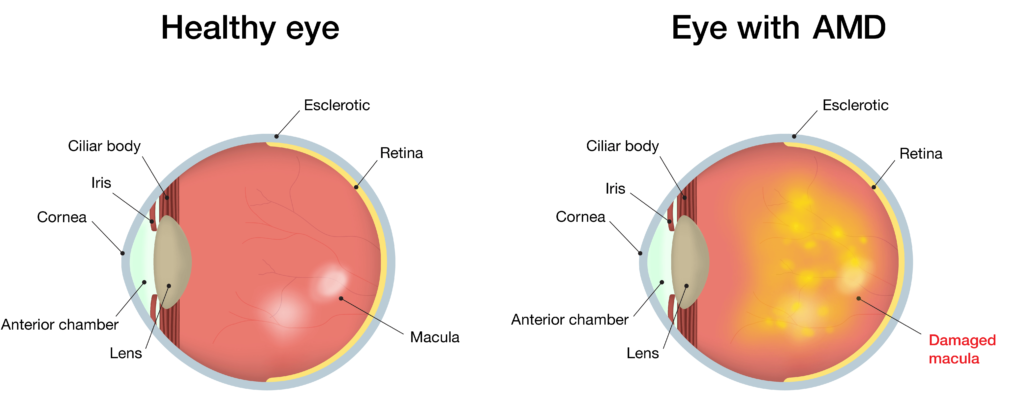 Image courtesy of Orange County Retina. AMD affects the central vision while peripheral vision remains normal.
What is AMD?
AMD is a problem with your retina. It happens when a part of the retina called the macula is damaged. With AMD, you lose your central vision. You cannot see fine details, whether you are looking at something close or far. But your peripheral (side) vision will still be normal.
Types and Stages of AMD
There are two types of AMD: dry and wet. Most people with AMD have dry AMD. This is when the macula gets thinner with age. Dry AMD happens in three stages: early, intermediate, and late. Wet AMD is less common but much more serious. Wet AMD is when new, abnormal blood vessels grow under the retina. These vessels may leak blood or other fluids, causing scarring of the macula.
Symptoms of AMD
The symptoms of AMD depend on the stage. Early dry AMD doesn’t cause any symptoms. In intermediate dry AMD, some people still have no symptoms. Others may notice mild symptoms, like mild blurriness in their central vision or trouble seeing in low lighting. In late AMD (wet or dry type), many people notice that straight lines start to look wavy or crooked.
Am I at Risk for AMD?
You are more likely to develop AMD if you:
- Eat a diet high in saturated fat (found in foods like meat, butter, and cheese)
- Are overweight
- Smoke cigarettes
- Are over 50 years old
- Have hypertension (high blood pressure)
- Have a family history of AMD
How Can I Lower My Risk for AMD?
Research shows that you may be able to lower your risk of AMD (or slow vision loss from AMD) by making these healthy choices:
- Quit smoking
- Get regular physical activity
- Maintain healthy blood pressure and cholesterol levels
- Eat healthy foods, including leafy green vegetables
What is the Treatment for AMD?
For dry AMD, there is currently no treatment. However, vision aids can help reduce the effect on your life. For wet AMD, treatments include anti-VEGF drugs, which are injected into the eye on a regular basis. A new, higher-dose version of well-established anti-VEGF medicine Eylea may allow patients to go longer in between injections.
References
- What is AMD: American Academy of Ophthalmology
- AMD Facts: National Eye Institute
- Image Credit: Orange County Retina